

How to Choose the Best Heated Jacket for Extreme Cold
Last Updated: November 4, 2026
Quick Summary
The best heated jacket for extreme cold combines usable battery runtime, well-placed heat zones, and a windproof, water-resistant shell that holds warmth in. Check runtime on high, confirm at least two front heating zones, and measure your chest against the size chart so the elements sit close to your body.
- Typical battery life on high settings runs about 2.5 to 3 hours.
- Cold slows lithium-ion reactions, so keep the power bank warm in an inside pocket.
- Look for a minimum IPX4 water resistance rating for wet, cold conditions.
- Measure your chest, not your usual shirt size, when choosing fit.
- Confirm the battery is replaceable and the heating elements are covered by warranty.
Table of Contents
- What Actually Separates a Heated Jacket That Works in Extreme Cold
- Battery Runtime, Capacity and Cold-Weather Performance
- Heat Zones, Carbon Fiber Elements and Temperature Settings
- Water Resistance, Windproofing and Insulation That Hold Heat
- Finding the Best Heated Jacket for Extreme Cold Men's and Women's Fit
- Rechargeable Heated Jackets: Power Banks, Charging and Safety
- How the Ororo Heated Jacket Compares on Specs and Durability
- Pick Your Heated Layer and Get Outside
- Frequently Asked Questions
What Actually Separates a Heated Jacket That Works in Extreme Cold
The best heated jacket for extreme cold is one that keeps working when the temperature drops well below freezing, and that comes down to battery chemistry, insulation, and how the heat is distributed, not the marketing on the box. There is no shortage of heated jacket options. The problem is that many of them are built for a chilly morning commute, not a full shift in real cold.
At RuggedClimate™, we build USB-powered heated apparel for people who spend hours outside. A heated jacket is a garment that uses battery-powered heating elements, usually carbon fiber, to add active warmth on top of traditional insulation. Three things decide whether it works in extreme cold: usable battery runtime, heat zone placement, and a shell that holds warmth in. Get those right and a heated layer changes your whole day. Get them wrong and you own an expensive vest.
Below, we break down exactly what to check before you buy, including the specs most guides skip.
Battery Runtime, Capacity and Cold-Weather Performance
Runtime is where heated jackets live or die, and the honest answer is that high heat drains a battery fast. Outdoor Life's heated gear testing found that typical battery life on high settings runs about 2.5 to 3 hours, while Forbes' roundup of top heated jackets notes that high-end models can stretch to around 10 hours on lower settings. That gap matters: a jacket claiming "all day" heat is almost always talking about the lowest setting.
Cold itself works against you, and it helps to understand why. Lithium-ion batteries produce current through chemical reactions, and those reactions slow down as temperatures fall. The result is higher internal resistance, which means the pack delivers less usable capacity and voltage sag under load, so a pack that lasts six hours indoors may deliver noticeably less on a windy site, and the heating elements may not reach their rated output even when the battery indicator still shows charge. Keeping the pack warm matters as much as pack size, so carrying it in an inside pocket close to your body can help.
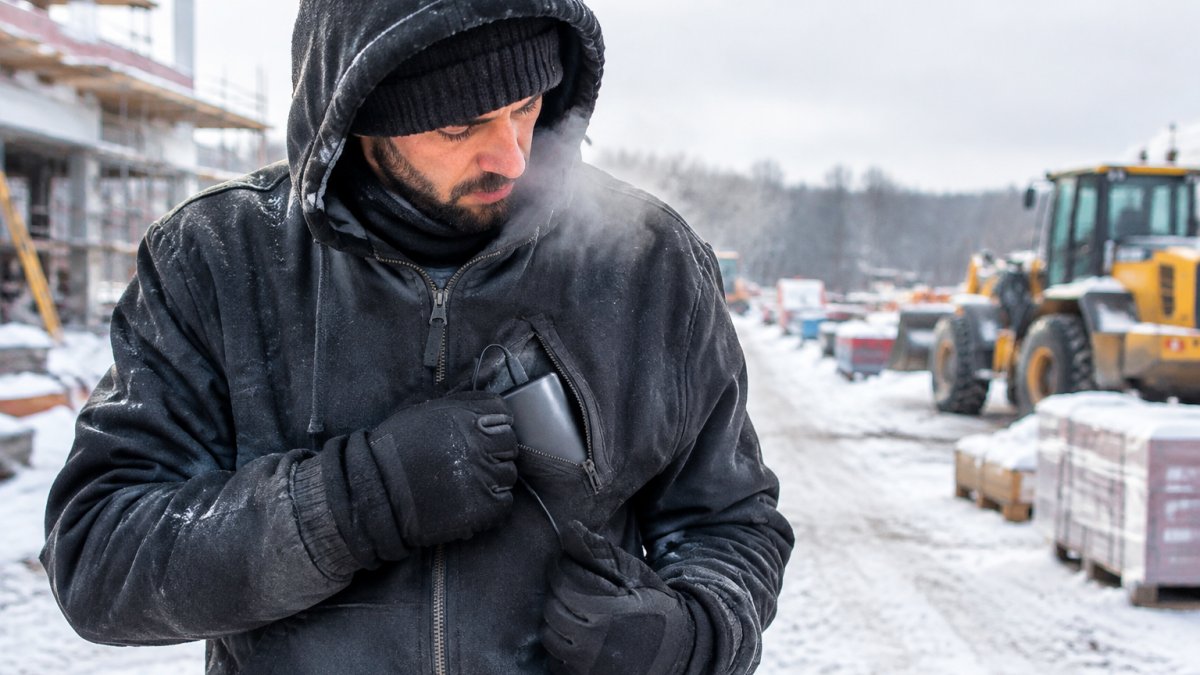
Battery weight is the spec nobody lists prominently, and it has a real ergonomic cost. A high-capacity pack adds bulk to a chest or back pocket, and that shifts how the jacket hangs, especially noticeable if you are swinging tools, carrying a pack, or wearing the jacket under a shell. A lighter pack you can swap mid-shift often beats one heavy brick that you feel in your shoulders by hour four. Our 50000mAh power bank uses USB-C input and has a digital display. For more questions, see our FAQ page.

Check that the pack and jacket are matched, not just compatible.
Heat Zones, Carbon Fiber Elements and Temperature Settings
Heat zone placement decides whether your core stays warm or just your shoulder blades. Most jackets heat the chest and back, which is smart: warming the core protects your whole body. Look for two front heating zones at minimum, and check where the elements sit relative to your body, since a panel that floats away from your torso wastes heat.
Carbon fiber heating elements are a common choice for heated apparel. Adjustable temperature settings matter just as much as raw output. Three settings let you run low heat to conserve battery on a mild afternoon and switch to high when the wind picks up. Our RuggedClimate™ heated hoodie offers three adjustable heat settings across two front heating zones.

Water Resistance, Windproofing and Insulation That Hold Heat
Active heating only helps if the shell keeps the warmth from blowing away. A windproof outer layer stops cold air from stripping heat off the surface, and a water-resistant shell keeps damp from soaking through, which is when heating elements and insulation both lose effectiveness. TideWe's cold-weather gear guidance recommends a minimum IPX4 water resistance rating for outdoor use in wet, cold conditions.
Insulation and active heating work as a pair. Down-filled or synthetic insulation traps your body heat, and the heating elements top it up in the spots that chill first. Some heated apparel combines traditional insulation with powered warmth for serious cold. Breathability matters too: a shell that traps sweat leaves you damp and colder once you stop moving. Look for moisture-wicking liners and vents you can open when you are working hard.
Finding the Best Heated Jacket for Extreme Cold Men's and Women's Fit
Fit is the most overlooked spec, and it decides whether you feel any heat at all. Heating elements need to sit close to your body to transfer warmth efficiently, so a jacket that fits like a loose shell wastes most of its output. When you search for the best heated jacket for extreme cold men's sizes, check the size chart against your chest measurement, not your usual shirt size, and size up only if you plan to layer a fleece underneath.
For the best heated jacket for extreme cold women's fit, the same rule applies with more attention to shoulder and torso length, since a jacket that rides up leaves your lower back exposed. A good heated layer should feel like normal clothing, not expedition gear. That matters if you are walking the dog at dawn and do not want to look like you are summiting something. Our heated hoodie is designed to look like everyday clothing.
RuggedClimate™ Heated Hoodie →
Rechargeable Heated Jackets: Power Banks, Charging and Safety
Rechargeable heated jackets run on a power bank, and the pack is half the purchase. Check three things: capacity in mAh, voltage output, and whether the connector matches. USB-C charging is now standard and far more convenient than proprietary plugs. A larger pack gives longer runtime but adds weight, so match capacity to how long you are actually outside.
Safety features deserve a look. Overheating protection and automatic shutoff prevent a runaway element from getting too hot, especially if the jacket gets bunched up under a seatbelt or strap. Certified packs reduce the risk of a cheap cell failing. Never use a damaged or swollen pack, and do not charge a cold-soaked battery until it reaches room temperature.
Watch out: buying a jacket without checking the power bank's voltage and connector can leave you with a pack that will not run the heating elements at full output, or will not connect at all.
How the Ororo Heated Jacket Compares on Specs and Durability
Durability is where budget heated jackets separate from the rest, and the gap is usually in the electronics, not the fabric. a Louisiana State University study on heated clothing notes that heated clothing is used in specialized environments including firefighting and severe cold, which means the electronics have to survive real abuse, not just a light walk. Common failure points in heated garments include connections and wiring, so inspecting them regularly is sensible.
Longevity of heated apparel varies, and care plays a large role. Wash on a gentle cycle with the battery removed, air dry, and check the wiring at the connection points each season.
Heating consistency and repairability are worth weighing when comparing heated gear. Ask before you buy: can the battery be replaced on its own, or is it a proprietary pack that costs half the jacket to replace? Is there a warranty that covers the heating elements, and for how long? Are the cables and connectors user-serviceable, or does a single frayed wire mean the whole garment is scrap? A jacket you can repair outlasts one you replace, and a replaceable battery alone can extend service life by years. Our RuggedClimate™ heated hoodie is a practical layer with USB-powered heating, two front zones, and three settings.
| What to Check | Why It Matters | What to Look For |
|---|---|---|
| Battery runtime | High heat drains fast | 2.5-3 hrs on high, longer on low |
| Heat zones | Core warmth vs. wasted output | Two front zones minimum |
| Water resistance | Damp kills heat | IPX4 or better for wet cold |
| Fit | Elements need body contact | Measure chest, not shirt size |
| Repairability | Electronics fail over time | Replaceable battery, real warranty |
Watch out: a warranty that covers the fabric but not the heating elements is common, read the exclusions before you assume a jacket is protected.
Pick Your Heated Layer and Get Outside
Choosing the best heated jacket for extreme cold comes down to matching runtime, heat zones, and fit to how you actually spend your hours outside. A road worker needs a swappable pack and a windproof shell. A dog walker needs a light layer that looks normal and heats the core. A skier needs insulation plus active heat and vents to dump sweat on the climb.
- Confirm runtime on high meets your longest stretch outside
- Check the power bank's voltage, connector, and weight
- Measure your chest and compare to the size chart
- Verify water resistance and windproofing for your conditions
- Confirm the battery is replaceable and the elements are covered
Ready to stop guessing? Our shipping and delivery page covers the details before you order.
Frequently Asked Questions
How long does a rechargeable heated jacket battery actually last in freezing weather?
Runtime depends on the heat setting and the battery. High-end models can reach up to 10 hours on lower settings, according to Forbes, while Outdoor Life reports typical battery life on high settings runs 2.5 to 3 hours. Cold itself reduces lithium-ion capacity, so a pack that lasts all day in a warm office will drain faster at -10°C. Carry a spare power bank if you work a full shift, and check the runtime figure against the setting you actually plan to use.
Are heated jackets warm enough for extreme cold on their own?
Active heating works best as part of a layering system, not as a replacement for insulation. The strongest setups pair a down-filled or softshell outer layer with carbon fiber heating elements and a moisture-wicking base layer against your skin. That combination traps heat retention while the elements add warmth where it matters. A heated jacket alone in deep cold will still leave your arms and lower body exposed, so treat it as one layer in cold-weather gear, not the whole kit.
Can you wash a battery-powered heated jacket?
Most rechargeable heated jackets are machine washable once you remove the power bank and disconnect the USB-C or DC cable from the heating elements. Check the care label first: water-resistant shells and softshell fabrics usually tolerate a gentle cycle, but heat-sensitive wiring does not belong in a tumble dryer. Air dry the jacket, confirm the connector port is fully dry, then reconnect the battery. Washing regularly keeps the heating elements and moisture-wicking lining working properly through a full winter.
What should you wear under a heated jacket in freezing weather?
Start with a thin moisture-wicking base layer, add a midweight fleece if you run cold, then the heated jacket over the top. Heating elements transfer warmth most efficiently when the jacket sits close to your body, so avoid bulky layers underneath that push the heat zones away from your torso. Keep the outer shell windproof and water-resistant to stop cold air stripping the heat you generate. For hands, choose a jacket with front heating zones near the pockets so your fingers stay functional on the job.
Cold weather does not have to end your day early. RuggedClimate™ builds heated apparel that keeps your core warm with three adjustable heat settings, two front heating zones, and USB-powered heating you can control as conditions change. Get started with RuggedClimate™ and stay comfortable through the coldest months.
